





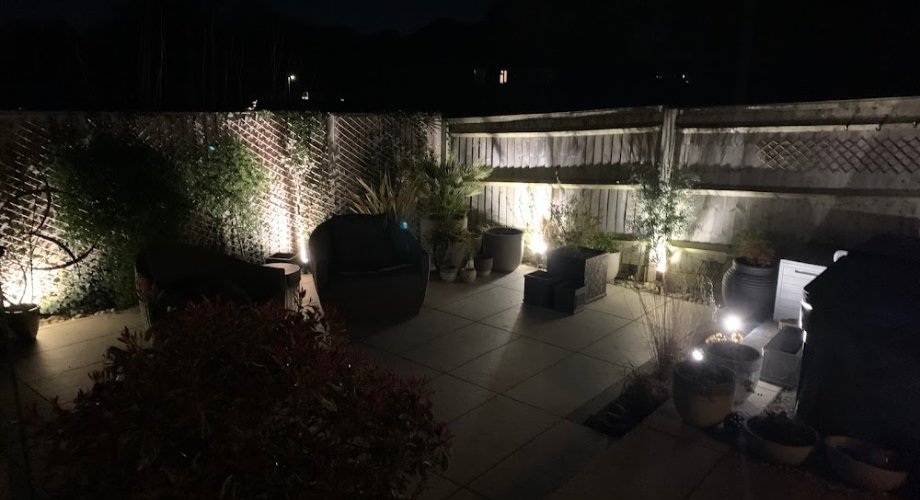

Good garden lighting changes how you use your outdoor space. Paths are easier to walk, the patio stays usable after dark, and the garden looks good from indoors too. But electricity and British weather are not natural friends, so outdoor lighting has to be chosen and installed with a lot more care than a light fitting indoors.
This guide covers the two things that matter most: keeping water out, and keeping people safe.
Why outdoor lighting is different
Indoors, a light fitting lives in a dry, stable environment. Outdoors, it deals with rain, frost, condensation, soil, garden chemicals, insects, and the occasional knock from a spade or mower. Anything that isn't made for those conditions will fail, and a failing electrical fitting outdoors is a real shock risk, not just an inconvenience.
That's why every part of a garden lighting system matters: the fittings, the cable, the connections and the protection back at the consumer unit.
Waterproofing: what IP ratings actually mean
Every outdoor light should carry an IP (Ingress Protection) rating. It has two digits. The first tells you how well the fitting keeps out solid objects and dust, on a scale of 0 to 6. The second tells you how well it keeps out water, on a scale of 0 to 8. The higher the number, the better the protection.
As a rough guide:
- IP44 is protected against splashing water. It suits sheltered spots, such as a wall light under a porch or eaves.
- IP65 is dust-tight and protected against water jets. It's a sensible choice for exposed walls, fences and posts that take the full force of the weather.
- IP67 can cope with temporary immersion. It's the usual choice for ground-level and recessed fittings, such as deck lights and driveway markers, where water can pool.
- IP68 is made for continuous submersion. It's what you need for lights that sit in a pond or water feature.
The right rating depends on where the light is going, not just on the fact that it's outdoors. A fitting that's fine under a canopy may not last a winter at the bottom of a border.
The weak point is usually the connection
In our experience of fault finding, the fitting itself is often not the problem. Water gets in at the joints: where cables are connected, where a cable enters a fitting, or where a seal has perished.
A few things make a big difference:
- Joints made in proper weatherproof enclosures or gel-filled connectors, never tape.
- Cable glands tightened correctly, so the cable entry is sealed.
- Fittings positioned so water drains away rather than sitting against seals.
- Seals and gaskets checked whenever a lamp or fitting is replaced.
Electrical safety outdoors
RCD protection. An RCD switches the power off very quickly if it detects electricity leaking to earth, which is what happens if someone touches a damaged cable or a waterlogged fitting. It is essential for outdoor circuits. If your garden lights keep tripping the RCD, that's the device doing its job, and the cause needs finding.
The right cable, in the right place. Ordinary indoor cable is not suitable outside. Buried mains cables should be armoured and laid deep enough, and along a sensible route, so they won't be caught by digging or planting later. It's worth keeping a note of where they run.
Ponds and water features. Water raises the stakes. Lights in or beside water need the correct IP rating and the right type of supply, and this is not a job for guesswork.
Sensible positioning. Keep fittings and cables clear of mower and strimmer routes, and avoid lights that will get hot where children or pets can touch them.
Looking after your lights
A quick check now and then goes a long way:
- Look for cracked lenses, condensation inside fittings and perished seals.
- Clear soil, leaves and mulch away from ground lights.
- Check for damaged or exposed cable after any digging or landscaping.
- If a light trips the power, leave it switched off until it's been looked at.
DIY or electrician?
Simple plug-in lighting kits are designed for homeowners to fit, as long as you follow the manufacturer's instructions and plug them into an RCD-protected socket. Anything involving mains wiring, new circuits, buried cables or water features should be done by a qualified electrician, then tested and certified.
Wycombe Electrical is NICEIC registered, and we design and install garden lighting across High Wycombe, Beaconsfield, Amersham, Marlow and Chesham. If you'd like advice on lighting your garden safely, get in touch or take a look at our garden lighting page.